
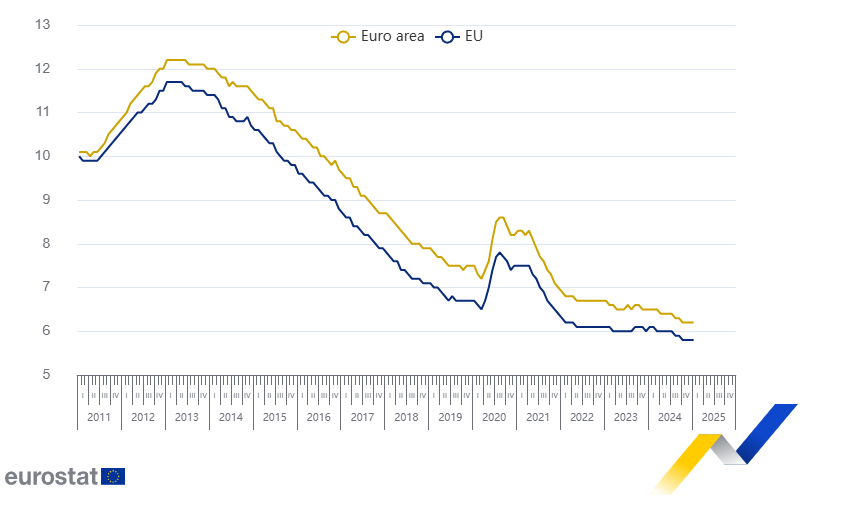
The European labor market shows signs of stability and improvement. According to Eurostat, in January 2025, the seasonally adjusted unemployment rate in the Eurozone stood at 6.2%, remaining stable compared to December 2024 and decreasing from 6.5% in January 2024. In the European Union (EU), the unemployment rate was 5.8%, also unchanged from the previous month and lower than the 6.1% recorded in January 2024.
It is estimated that in January 2025, there were 12.824 million unemployed people in the EU, of which 10.655 million were in the Eurozone. Compared to December 2024, the number of unemployed people decreased by 8,000 in the EU and by 42,000 in the Eurozone.
Unemployment among young people under 25 years old remains a challenge. In January 2025, 2.856 million young people were unemployed in the EU, including 2.263 million in the Eurozone. The youth unemployment rate stood at 14.6% in the EU, unchanged from December 2024, and 14.1% in the Eurozone, slightly down from 14.2% the previous month.
In January 2025, the unemployment rate for women in the EU remained at 6.0%, while for men, it was 5.6%, both unchanged from December. In the Eurozone, the unemployment rate for women was 6.4%, and for men, 6.0%, also showing no monthly variation.
The figures reflect a positive trend in unemployment reduction, with 510,000 fewer unemployed people in the EU and 547,000 fewer in the Eurozone compared to January 2024.
The data, based on the International Labour Organization (ILO) definition of unemployment, highlights the resilience of the European labor market, though challenges remain in youth employment and the integration of specific workforce segments.
source: EUROSTAT
En este sitio web utilizamos cookies para mejorar tu experiencia, ofrecerte contenido y publicidad personalizada. Tú tienes el control sobre qué cookies deseas permitir. Puedes informarte más y gestionar tus preferencias de cookies en cualquier momento.
Las cookies necesarias son cruciales para las funciones básicas del sitio web y el sitio web no funcionará de la forma prevista sin ellas. Estas cookies no almacenan ningún dato de identificación personal.
| Cookie | Duración | Descripción |
|---|---|---|
| PHPSESSID | Sesión | Recordar sesión del usuario en la web (tokenizada como valor clave alfanumérica aleatoria de 60 caracteres). |
Las cookies funcionales ayudan a realizar ciertas funcionalidades, como compartir el contenido del sitio web en plataformas de redes sociales, recopilar comentarios y otras características de terceros.
Las cookies analíticas se utilizan para comprender cómo interactúan los visitantes con el sitio web. Estas cookies ayudan a proporcionar información sobre métricas el número de visitantes, el porcentaje de rebote, la fuente de tráfico, etc.
| Cookie | Duración | Descripción |
|---|---|---|
| _ga | 2 años | Se usa para diferenciar usuarios (anonimizada desde la inserción). |
| _gat | 24 horas | Se usa para diferenciar usuarios (anonimizada desde la inserción). |
| _gid | 1 minuto | Se usa para diferenciar usuarios (anonimizada desde la inserción). |
Las cookies de rendimiento se utilizan para comprender y analizar los índices de rendimiento clave del sitio web, lo que ayuda a proporcionar una mejor experiencia de usuario para los visitantes.
Las cookies publicitarias se utilizan para entregar a los visitantes anuncios personalizados basados en las páginas que visitaron previamente y para analizar la efectividad de la campaña publicitaria.